Garage Door Repair
The Complete Guide to Garage Door Repair in Miami, Florida
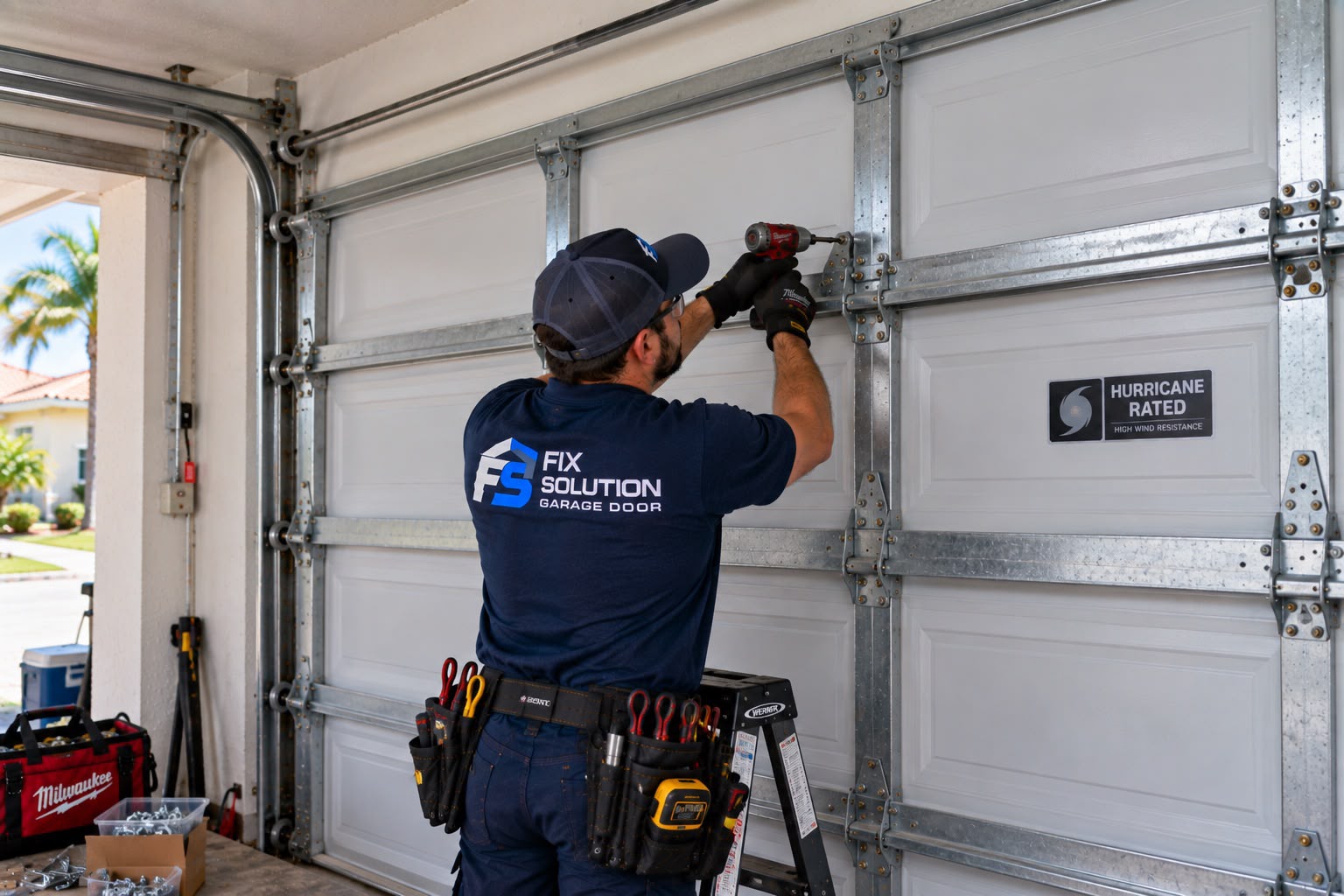
A garage door is one of the largest moving systems in your home. In South Florida, it also faces conditions that garage doors in many other parts of the country simply do not experience.
Heat, humidity, heavy rain, coastal air, frequent daily use, and hurricane-season wind requirements can all affect how a garage door performs and how it should be maintained.
Whether your garage door won't open, a spring has broken, the door has come off track, your opener has stopped working, or you're considering a new hurricane-rated garage door, understanding the system can help you make a better decision about the next step.
This guide from FIX SOLUTION GARAGE DOOR explains the most common garage door repair problems Miami homeowners encounter, what may cause them, when a repair may be appropriate, and when professional garage door service should be considered.
Understanding your garage door system
A modern garage door is more than a door and a motor.
The complete system may include:
- Door panels or sections
- Torsion or extension springs
- Lift cables
- Cable drums
- Rollers
- Vertical and horizontal tracks
- Hinges
- Bearings
- Brackets
- Weather seals
- Safety sensors
- Garage door opener
- Rail or drive system
- Wall controls
- Remotes and keypads
- Reinforcement hardware
These components work together every time the garage door opens or closes.
A problem with one component can sometimes affect several others.
For example, a door that appears to have an opener problem may actually have a broken spring. A door that appears crooked may have a cable or track problem.
That is why proper diagnosis is important before replacing parts.
Common garage door problems in Miami
1. Broken garage door springs
Garage door springs help counterbalance the weight of the door.
Depending on the system, a residential garage door may use torsion springs mounted above the door or extension springs positioned along the sides of the door system. See our broken spring repair service in Miami for how this work is handled.
Common signs of a possible broken spring include:
- A loud bang from the garage
- A visible separation in a torsion spring
- A garage door that suddenly feels extremely heavy
- A door that opens only a few inches
- An opener that struggles to lift the door
- A door that will not open at all
A broken spring is not simply an inconvenience.
Garage door springs operate under significant tension.
2. Garage door won't open
A garage door that won't open can have several possible causes.
These may include:
- Broken spring
- Damaged lift cable
- Garage door opener failure
- Disconnected opener
- Electrical problem
- Remote or keypad problem
- Door obstruction
- Track damage
- Roller problem
- Door binding in the tracks
One useful distinction is whether the problem originates in the door itself or in the opener.
A garage door opener is designed to move a properly balanced garage door. It should not compensate for a major mechanical failure.
If the door has become unusually heavy, crooked, jammed, or difficult to move, repeatedly activating the opener can potentially create additional damage. When the car is trapped or the home cannot be secured, this becomes an emergency repair situation.
3. Garage door won't close
A garage door that opens but refuses to close is another common service call.
Possible causes include:
- Misaligned safety sensors
- Dirty sensor lenses
- Something blocking the sensor path
- Damaged sensor wiring
- Track obstruction
- Incorrect travel settings
- Opener malfunction
- Mechanical resistance in the door
- Damaged rollers or tracks
Modern garage door openers use safety systems designed to reduce the risk of the door closing onto an obstruction.
If the door begins closing and immediately reverses, the safety system, travel settings, or mechanical condition of the door may need to be checked.
4. Garage door off track
A garage door can become partially or completely displaced from its tracks — the situation our off-track door service addresses.
This may happen because of:
- Cable failure
- Impact from a vehicle
- Damaged rollers
- Bent tracks
- Loose track brackets
- Uneven spring tension
- An obstruction
- Operating the door while another component is damaged
An off-track garage door should be treated carefully.
5. Broken or damaged garage door cables
Lift cables are a critical part of many garage door systems.
They work with the spring system to raise and lower the door.
Signs of cable trouble may include:
- Frayed cable
- Loose cable
- Cable hanging beside the door
- Door lifting unevenly
- One side of the door sitting lower than the other
- Cable coming off the drum
- Door becoming jammed
Cable problems can sometimes be symptoms of another issue rather than the original failure.
For example, a cable may come off a drum because the door became uneven, a spring failed, or the door encountered an obstruction.
The complete lifting system should therefore be inspected rather than simply putting the cable back into position — see cable repair in Miami.
Not sure which part failed?
A technician can inspect the garage door, explain the problem and provide the price before any repair work begins. The estimate is free.
Garage door roller and track problems
Rollers guide the garage door through its tracks.
When rollers, hinges, tracks, or related hardware become worn or damaged, you may notice:
- Grinding
- Squeaking
- Jerky movement
- Excessive vibration
- Door shaking
- Roller leaving the track
- Uneven movement
- Increased operating noise
Some noise can result from normal wear or insufficient maintenance.
Other noises can indicate a component that is beginning to fail.
Ignoring unusual movement can sometimes allow a relatively small hardware problem to develop into a larger repair. Worn hardware is addressed through roller and track repair.
Garage door opener problems
The opener is only one part of the garage door system.
Common opener-related problems include:
- Motor runs but door does not move
- Remote does not work
- Wall button does not work
- Door reverses unexpectedly
- Opener makes unusual noise
- Door opens partially
- Door closes partially
- Keypad does not respond
- Safety sensors do not communicate correctly
- Smart opener connectivity problems
Popular residential opener systems may use:
- Belt drive
- Chain drive
- Screw drive
- Jackshaft or wall-mount configurations
Smart garage door openers may also provide features such as smartphone control, alerts, integrated cameras, battery backup, or remote access depending on the model. Motor, board, remote and keypad issues fall under opener repair and installation.
Garage door sensors
Safety sensors are typically positioned near the bottom of the garage door opening.
Problems can occur because of:
- Misalignment
- Dirt
- Physical impact
- Damaged wiring
- Loose connections
- Moisture
- Hardware movement
If the door opens normally but will not close, the sensors are one of the first components worth checking visually.
However, repeated sensor problems can sometimes indicate damaged wiring, mounting problems, or an opener issue that requires further diagnosis, which is part of opener and safety-sensor service.
Noisy garage door: when is noise a problem?
Garage doors naturally produce some sound.
But a noticeable change in sound should not automatically be ignored.
Different noises can be associated with different components.
Squeaking
May involve rollers, hinges, bearings, or lubrication.
Grinding
May indicate worn rollers, bearings, opener components, or metal-to-metal contact.
Popping
Can be related to movement in door sections or components under tension.
Scraping
May indicate track, roller, cable, or alignment problems.
Sudden loud bang
A loud bang from the garage can be associated with a spring failure.
If the door behaves differently immediately after a loud noise, avoid repeatedly operating it until the system has been checked.
Garage door repair vs. replacement
Not every garage door problem requires a new door.
Many problems can potentially be repaired.
Repair may make sense when:
- A spring has failed
- Rollers are worn
- Cables need replacement
- An opener has failed
- Sensors need service
- Track damage is limited
- Individual hardware components are worn
- The door itself remains structurally sound
Replacement may deserve consideration when:
- Multiple panels are severely damaged
- The door has significant structural damage
- Corrosion is extensive
- Repair costs are becoming repetitive
- The existing door no longer meets the homeowner's needs
- Energy efficiency is a concern
- The homeowner wants improved appearance or functionality
- A properly rated hurricane-resistant system is desired
The right decision depends on the condition of the complete system rather than the age of a single component. Damaged sections are sometimes handled through panel repair, while a full swap falls under door replacement or new door installation.
Garage door repair costs in Miami
One of the most common questions homeowners ask is:
“How much does garage door repair cost?”
There is no single accurate price for every garage door repair.
The final cost can depend on:
- Type of problem
- Door size
- Door weight
- Door material
- Spring configuration
- Number and type of replacement parts
- Opener model
- Track condition
- Existing damage
- Accessibility
- Whether multiple components were damaged
A broken spring on one door may involve a different spring configuration from another door that looks almost identical from the outside.
The same is true for cables, openers, panels, rollers, and tracks.
For this reason, an on-site inspection is often the most reliable way to determine the actual repair required.
At FIX SOLUTION GARAGE DOOR, the estimate is free. A technician can inspect the garage door and provide the price before repair work begins.
Garage doors and Miami's climate
Garage doors in South Florida operate in a challenging environment.
Miami homeowners should pay particular attention to several conditions.
Humidity
Persistent humidity can affect metal components, electrical connections, hardware, and other parts of a garage door system over time.
Coastal air
Homes closer to the coast may experience increased exposure to salt in the air.
Metal hardware should be periodically inspected for signs of corrosion.
Heavy rain
Weather seals and the bottom seal of the garage door can deteriorate over time.
Damaged seals can allow water, insects, dirt, and outside air into the garage.
Heat
Garages can become extremely hot.
Heat can affect comfort inside attached garages and may influence a homeowner's decision to consider an insulated garage door.
Hurricane-rated garage doors in Miami
For Miami homeowners, hurricane resistance is an especially important garage door topic.
A garage door represents a very large opening in the exterior envelope of a home.
Garage door systems used in South Florida may need to satisfy specific wind-load and product-approval requirements depending on the property, installation, applicable code, and location. Our hurricane-rated garage door page covers this in more detail.
Miami-Dade County is part of Florida's High Velocity Hurricane Zone (HVHZ).
Garage door systems intended for these conditions may incorporate features such as:
- Reinforced door sections
- Heavier-duty tracks
- Additional track attachment points
- Reinforcement struts
- Stronger hardware
- Specific anchoring requirements
- Impact-resistant components where applicable
- Tested wind-pressure ratings
A door should not simply be described as “hurricane rated” because it looks stronger than a standard door.
The specific product, approval documentation, design pressures, opening dimensions, anchoring method, installation configuration, and property requirements all matter.
What is a Miami-Dade NOA?
Homeowners researching hurricane-resistant products in South Florida may encounter the term NOA, or Notice of Acceptance.
Miami-Dade County maintains a Product Control system for building products intended for use under applicable conditions, including products designed for the High Velocity Hurricane Zone.
Garage door approval documentation can contain information such as:
- Approved door models
- Maximum dimensions
- Design pressure ratings
- Impact classifications
- Reinforcement configurations
- Track requirements
- Hardware requirements
- Fastener requirements
- Installation details
The correct door and installation configuration must match the requirements applicable to the actual opening and structure.
Hurricane garage door reinforcement
Some garage door systems use reinforcement components designed to help the door resist wind pressure.
Depending on the approved system, these may include:
- Horizontal reinforcement struts
- Reinforced tracks
- Additional brackets
- Heavier hinges
- Specific fasteners
- Structural supports
- Wind-load reinforcement systems
However, adding random metal braces to an existing garage door does not automatically make it hurricane-rated.
The door system needs to be evaluated as a complete assembly.
Preparing your garage door for hurricane season
Before severe weather threatens South Florida, homeowners should visually inspect the garage door system.
Look for:
- Loose hardware
- Bent tracks
- Damaged panels
- Corrosion
- Frayed cables
- Worn rollers
- Missing reinforcement
- Damaged weather seals
- Unusual door movement
- Existing structural damage
If the door is part of an approved wind-resistant system, make sure any required reinforcement components are present and used according to the manufacturer's approved configuration.
Do not wait until a storm is approaching to discover that critical hardware is damaged or missing.
Garage door maintenance in South Florida
Routine inspection can help identify problems before they become emergency repairs — the purpose of scheduled garage door maintenance.
A homeowner can periodically look for:
- Loose visible hardware
- Rust or corrosion
- Frayed cables
- Damaged weather stripping
- Unusual noises
- Uneven movement
- Damaged rollers
- Bent tracks
- Sensor obstruction
- Visible panel damage
Professional maintenance may include inspection of:
- Springs
- Cables
- Drums
- Bearings
- Rollers
- Hinges
- Tracks
- Door balance
- Opener operation
- Safety reversal system
- Sensors
- Fasteners
- Reinforcement hardware
When is garage door repair an emergency?
Some problems should be addressed promptly.
Examples include:
- Garage door stuck open
- Door hanging at an angle
- Door off track
- Broken spring preventing access
- Broken cable
- Door that may fall
- Vehicle trapped inside
- Garage unable to secure the home
- Storm damage
- Major structural damage to the door
- Garage door unable to close before severe weather
If the door appears unstable, avoid standing underneath it or repeatedly trying to operate it.
Should you repair a garage door yourself?
Homeowners can perform some basic observations and simple maintenance tasks.
Examples may include:
- Checking for obvious obstructions
- Cleaning sensor lenses
- Replacing remote batteries
- Visually inspecting weather seals
- Checking whether electrical power is available
But certain garage door repairs involve substantial stored energy or heavy moving components.
These include work involving:
- Torsion springs
- Extension springs
- Lift cables
- Cable drums
- Structural track problems
- Heavy door sections
- Major door alignment issues
These repairs are generally better handled by someone with appropriate garage door training and equipment.
Choosing a garage door service company in Miami
When comparing garage door companies, do not evaluate a company only by the first price mentioned over the phone.
Useful questions may include:
- Will the door be inspected before repair?
- Will I receive the price before work begins?
- What exactly is being replaced?
- Why does the component need replacement?
- Does the proposed part match the door?
- For a new door, what product approval applies?
- What design pressure is required?
- What is included in the installation?
- What warranty applies to the specific work?
A professional inspection should help you understand both the problem and the proposed solution.
Frequently asked questions about garage door repair in Miami
Need garage door service in Miami?
If your garage door is broken, stuck, noisy, off track, has a damaged spring or cable, or the opener isn't working correctly, FIX SOLUTION GARAGE DOOR can inspect the system and help determine the appropriate repair.
We also assist homeowners considering garage door replacement, installation, opener service, and hurricane-related garage door solutions.
Professional garage door service for Miami and surrounding service areas in Miami-Dade County.
Schedule a Free Estimate
A technician can inspect the garage door, explain the problem and provide the price before any repair work begins.
Prefer to call FIX SOLUTION?
A technician can inspect the garage door, explain the problem and provide the price before any repair work begins. The estimate is free.
Related guides
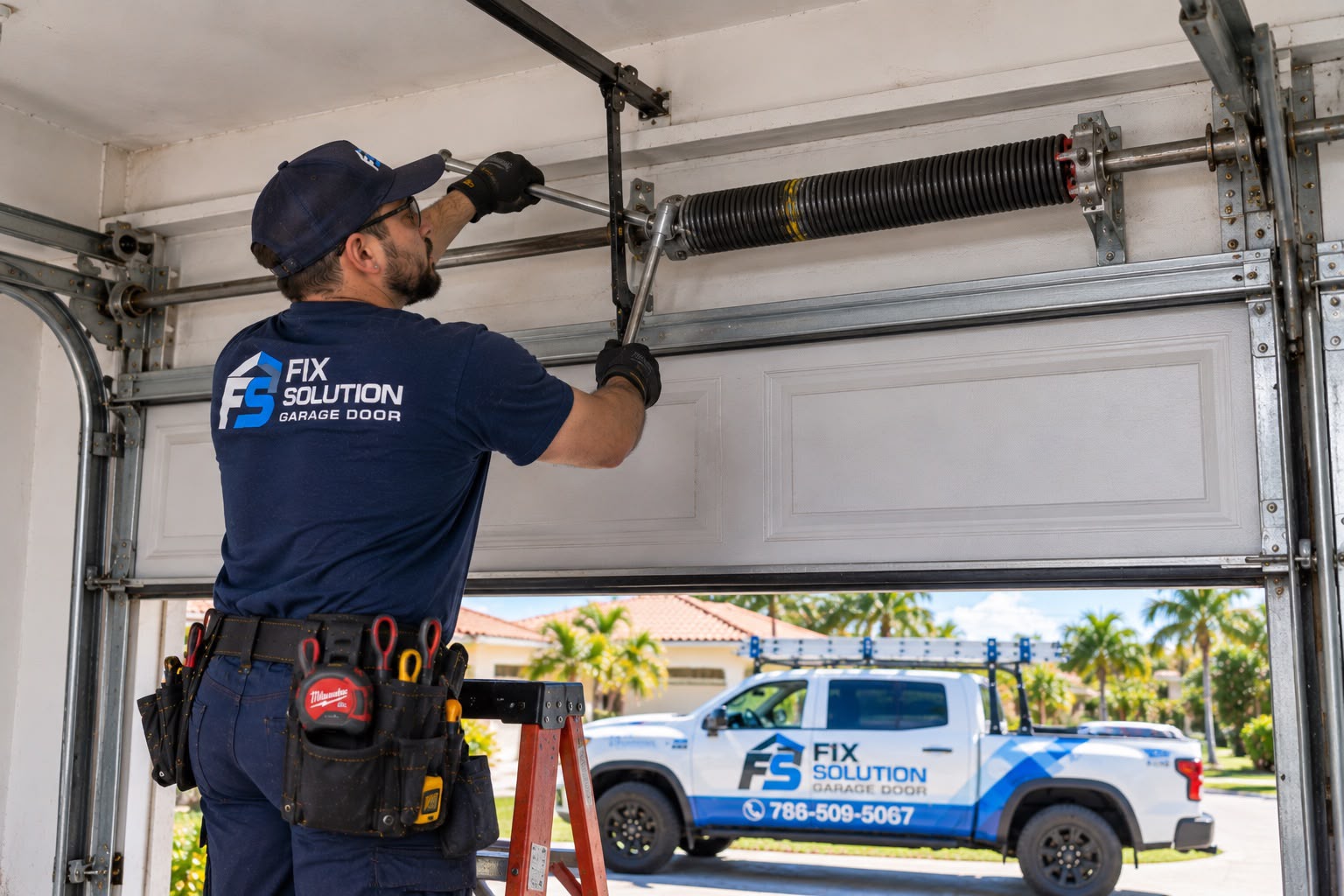
Garage Door Repair Cost in Miami: What Homeowners Should Know
What actually affects the price of a garage door repair in Miami — springs, openers, cables, tracks, rollers, panels, emergency service and hurricane-rated systems.
Read ArticleGarage Door Won't Open? Common Causes and What to Do
Springs, openers, cables, rollers, tracks and power problems can all stop a garage door from opening. Here is how they differ.
Read Article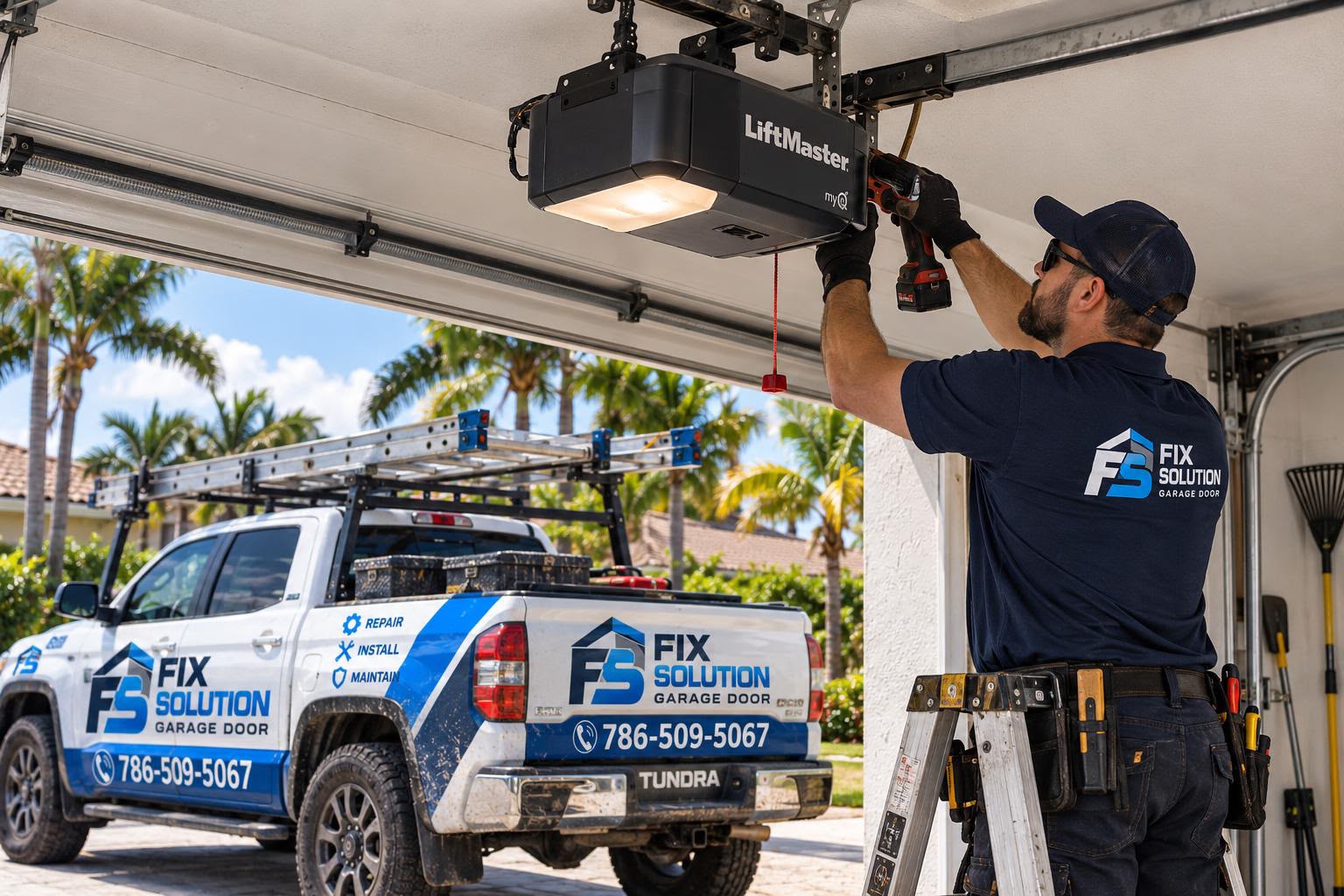
Garage Door Won't Close? What Homeowners Should Check
Safety sensors, obstructions, tracks, rollers and opener components are the usual reasons a garage door opens but refuses to close.
Read Article